Tuesday, June 29, 2021

Bicep Tendinitis

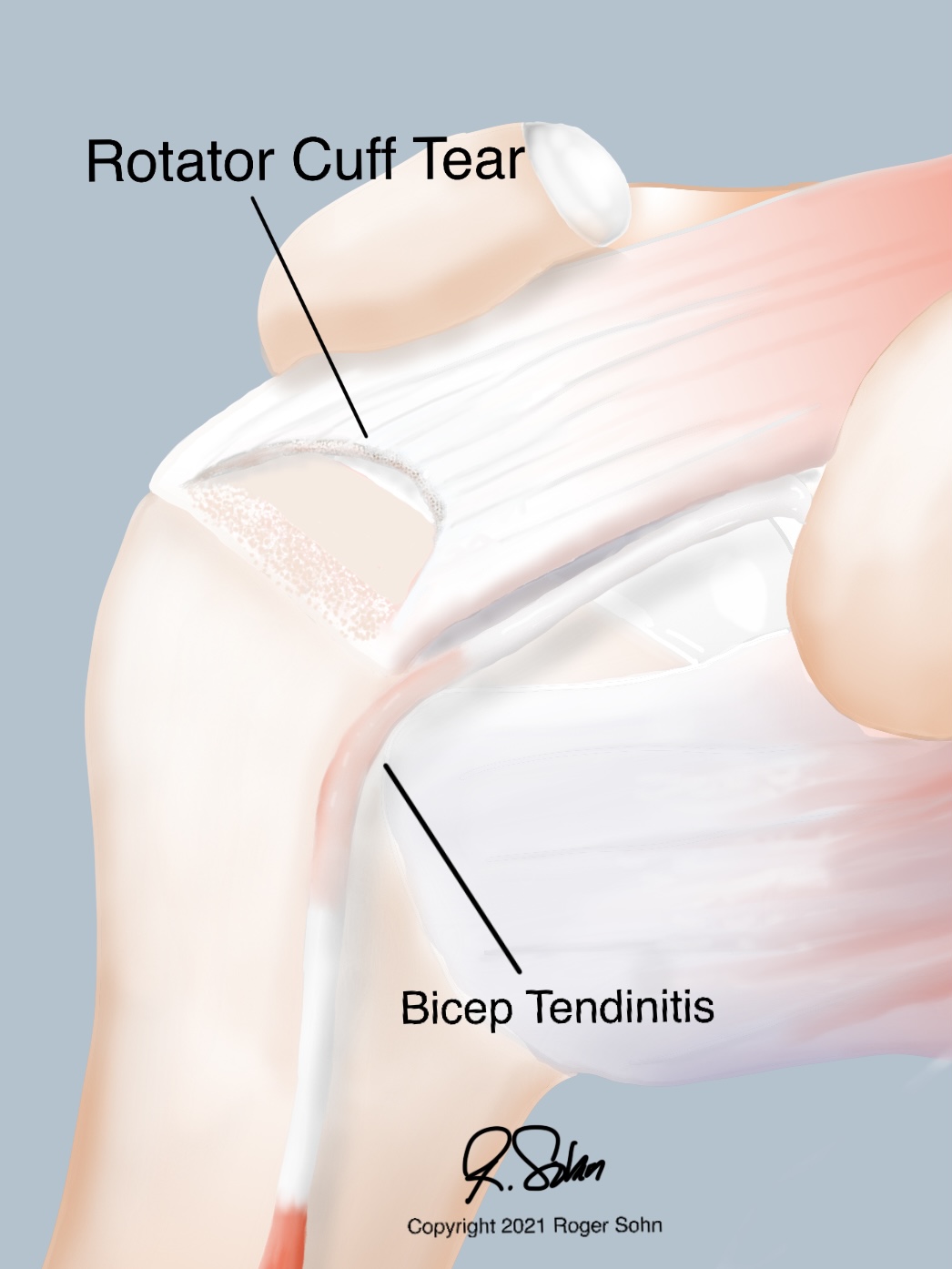
 Bicep Tendinitis:

This is by far the most common shoulder problem I see.  As you can see in the picture, the long head of the bicep tendon has to curve sharply as it enters the shoulder.  This is one of the only tendons in the body that bends at a sharp angle.  It probably explains why people get irritation and swelling on the portion of the tendon that rubs on the "corner" of the shoulder.  This causes a sharp pain in the front of the shoulder.  The pain can radiate down into the bicep muscle and occasionally into the forearm.  

These symptoms can be relieved with a bicep tenodesis surgery.  This is an arthroscopic surgery that fixes the damaged bicep tendon to the humerus so it can no longer rub and cause pain.  


Rotator Cuff Tear

 Rotator Cuff Tear:

This is probably the second most common injury of the shoulder I see.  The deep layer of shoulder muscles is called the rotator cuff.  People can tear one or more of these tendons leading to pain and weakness.  Patients describe this pain as a sharp or achy pain that emanates from the lateral side of the shoulder.  


We use an arthroscopic technique to repair the torn tendon.  We place bone anchors with sutures that secure the torn tendon back to the original position on the bone.  The tendon is held there by the suture tape while it heals.  It takes about 12 weeks for the tendon to fully adhere to the bone.  


Wednesday, June 23, 2021

Labral Tear

 The shoulder usually dislocates to the front, or anteriorly.  The rim of the socket, called the labrum, tears off the glenoid bone.  This torn labrum and the attached ligament is called a Bankart lesion.  It often will not heal, leading to further instability or dislocations of the shoulder.  


When we repair this type of lesion, we use an arthroscope to visualize the damage.  We then use suture anchors to repair the damaged ligaments and labrum.  This can lead to very satisfying results.  The chance of future dislocations is greatly reduced after a surgery like this. 


Wednesday, June 16, 2021

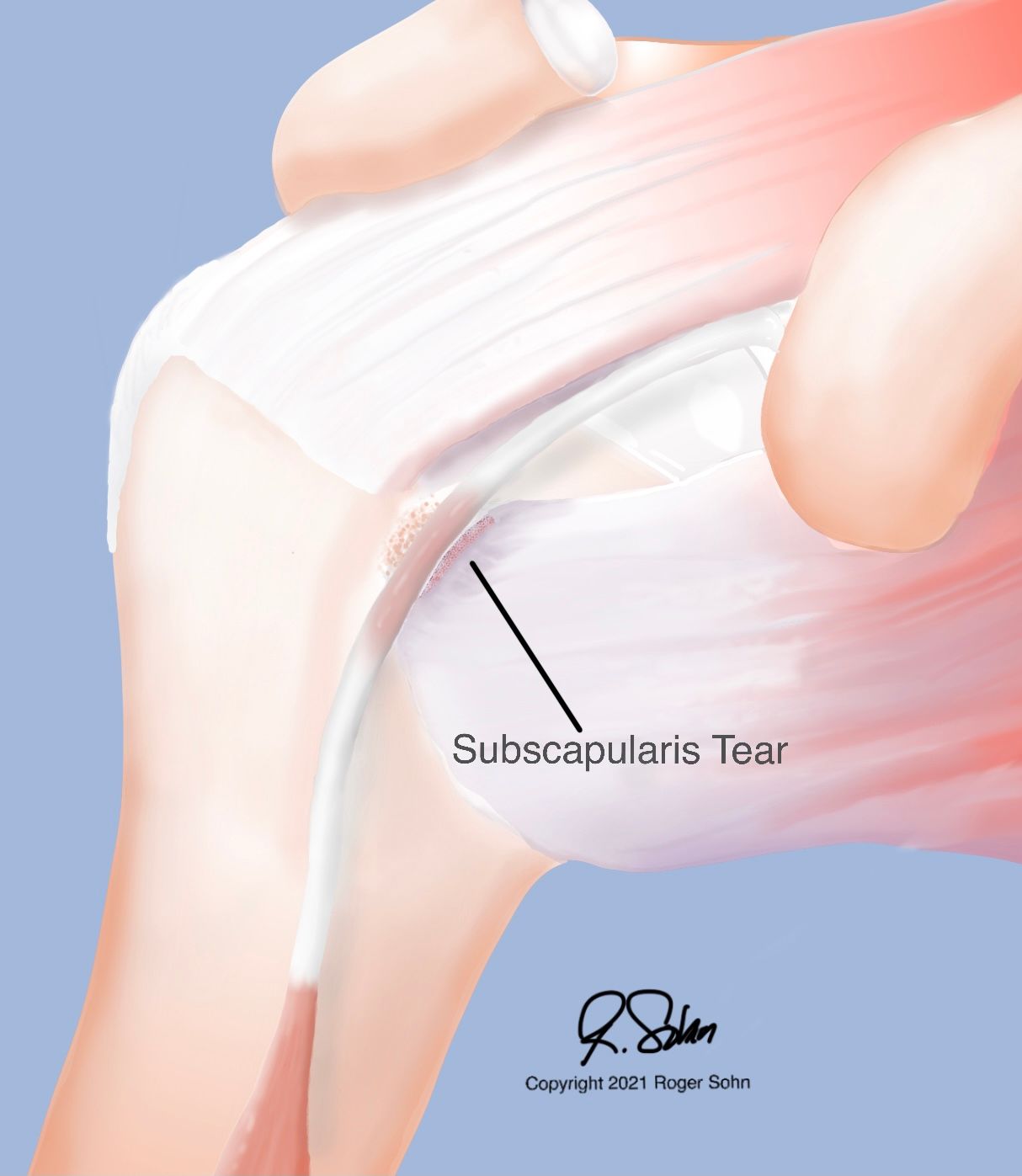
Subscapularis Tear

 One of the more common injuries I see is a tear of the upper subscapularis tendon.  The subscapularis is a part of the rotator cuff.  It is located in the front of the shoulder and is responsible for internally rotating the shoulder.  When the subscapularis tendon is injured, the adjacent long head of the bicep tendon can slip into the torn "corner" of the tear.  This can lead to weakness and pain in the front of the shoulder.


Saturday, June 5, 2021

PASTA Lesion

Among the many fun acronyms of the shoulder is the PASTA lesion.  PASTA stands for Partial Articular-sided Supraspinatus Tendon Avulsion.  It occurs when the undersurface of the supraspinatus tendon tears from the greater tuberosity.  This type of tear can only be seen from inside the joint since the outer portion of the tendon is still intact.  Although this is not a full thickness tear, it can cause significant pain and weakness of the shoulder.  There are arthroscopic options for fixing this problem, allowing for an accelerated recovery.  


We can repair these tears arthroscopically using percutaneous anchors.  This avoids detaching the intact outer portion of the tendon.  In some patients who have diseased or frayed tendon edges, a bovine collagen implant can augment the tendon thickness.  The Regeneten patch has been shown to integrate with the native tendon and restore function.


Sunday, May 16, 2021

Reverse Shoulder Replacement Mechanics

When the shoulder wears out, we sometimes have to place an artificial joint called a reverse total shoulder.  Sometimes we need to do this because of severe wearing out of the socket bone. Other times, we need to use this implant due to a chronic rotator cuff tear. This is an example of what the new shoulder looks like when we place a reverse shoulder replacement.


Saturday, May 1, 2021

Shoulder Arthritis

 One of the more common problems I treat is shoulder arthritis.  This is a painful condition of the shoulder due to the breakdown of the normal gliding cartilage surfaces of the joint.  This can be due to wear and tear or injuries.  Eventually, the joint can start to form bone spurs, which are abnormal bony outgrowths at the edges of the joint.  


With a shoulder replacement, we can restore the normal mechanics of the shoulder joint.  I prefer to do a total shoulder replacement using an artificial ball and an inset glenoid.  This particular arrangement has a lot of promise for creating a long-lasting joint.  The components are made by Shoulder Innovations and they have published data showing excellent longevity.  Of course, each patient's shoulder anatomy is different and I tailor the surgery to suit their needs.  Sometimes, we need to use a different type of glenoid (socket) component.  We may also need to perform a reverse shoulder replacement.  In many cases, we are able to achieve a painless shoulder with full return to activities.   


Friday, April 30, 2021

Common Shoulder Conditions

 I often get asked by patients to describe their injuries.  It is hard for many people to look at their MRI and to understand what they are looking at.  Here are a few examples of very common shoulder problems.


Bicep Tendinitis:

This is by far the most common shoulder problem I see.  As you can see in the picture, the long head of the bicep tendon has to curve sharply as it enters the shoulder.  This is one of the only tendons in the body that bends at a sharp angle.  It probably explains why people get irritation and swelling on the portion of the tendon that rubs on the "corner" of the shoulder.  This causes a sharp pain in the front of the shoulder.  The pain can radiate down into the bicep muscle and occasionally into the forearm.  


Rotator Cuff Tear:

This is probably the second most common injury of the shoulder I see.  The deep layer of shoulder muscles is called the rotator cuff.  People can tear one or more of these tendons leading to pain and weakness.  Patients describe this pain as a sharp or achy pain that emanates from the lateral side of the shoulder.  


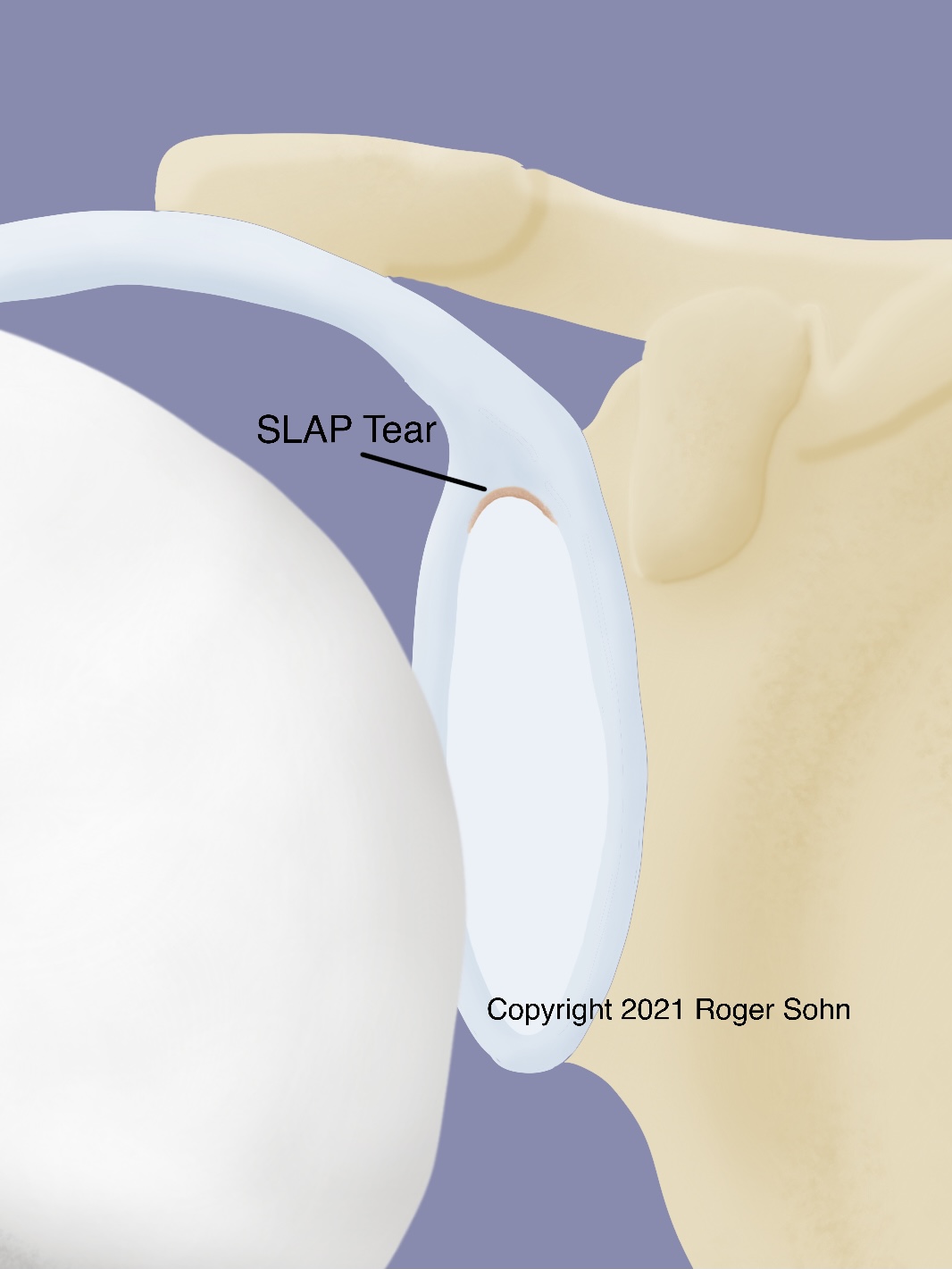
SLAP tear:
The long head of the bicep tendon attaches to the top of the shoulder socket.  It looks a bit like the trunk of a tree with a flared out base that attaches to the rim, also known as the labrum of the shoulder.  When the "roots" of the tree are torn, this is called a superior labrum anterior to posterior (SLAP) injury.  Injuries of the bicep and labrum complex can feel like a deep pain that radiates down the front of the shoulder.   


Sunday, January 31, 2021

Watch Dr. Sohn's Interview on TV6 Regarding Shoulder Arthritis.

Thanks to the folks at Laguna Woods TV6 and MemorialCare Saddleback Memorial Medical Center for the invitation to come on the show.  It was a fun discussion with host, Lisa Hart.  Our discussion covered topics ranging from COVID workouts to shoulder replacements.  Please watch and comment!


Monday, August 31, 2020

Are Telehealth Visits Any Good For Shoulder Problems?

 I've got to admit, I've been wondering about how good my ability to diagnose shoulder problems is when using virtual visits.  I am able to get most patients to point to where it hurts and to show me their range of motion.  I have found workarounds for most strength and sensation tests.  However, it wasn't till recently that I came across this article about how a virtual exam compares to a real (in person) exam.

The researchers took 62 patients and had one doctor do a virtual exam and another doctor do an in person examination.  The order of the exams was randomized.  50 of the tests were able to be compared against the gold-standard test, which was an MRI. 

Interestingly, they found about 70% accuracy of the tests in either the in-person or the virtual groups.  There was no significant difference in the accuracy between the two groups.  Thus, they determined that virtual visits are not inferior to in-person visits.  

Comment:  We use virtual visits when patients prefer to use it.  It is nice to know that this data supports our continued use of telehealth.  It has been invaluable in creating convenience for some patients who have recently had surgery and don't need to come in for their first postop visit.  


Tuesday, July 21, 2020

Webinar: Shoulder Arthritis

In this pre-recorded webinar, I discuss shoulder arthritis.  I discuss what it is and what are the treatment options.  I also discuss a technology that allows me to do the surgery more accurately.  

Tuesday, June 30, 2020

Sign Up For Dr. Sohn Webinar on Shoulder Arthritis

Please join Dr. Roger Sohn for a class hosted by Saddleback Memorial Medical Center's Joint Replacement Center.  Dr. Sohn will be discussing common shoulder problems and their treatments.  Space is limited so please sign up at memorialcare.org/SBClasses.

Sunday, June 28, 2020

Shoulder Before and After: Can You Spot the Change?


Before

After

I've written in the past about the suprascapular nerve and how it can get entrapped at the scapular notch.  I recently treated someone with a fairly rare case of entrapment of the nerve due to an ossified transverse scapular ligament.  This means the ligament has turned to bone.  Removing the ossified ligament requires a bit more care than usual.  With permission, here is the video of her surgery.